

RADIAL PROTOCOL
Radial protocol values
Pressure: 2.5 bar
Impulses: 5,000
Frequency: 12 Hz
Applicator: 15 mm trigger
Total energy flux density dose: 318 mJ/mm²
Number of sessions: 3 (1 per week)



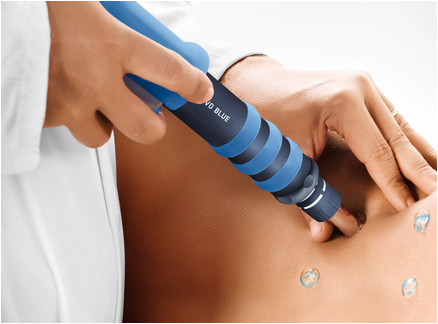
Medical information
Myofascial trigger points (MTrPs) are a common cause of chronic neck and back pain. They are localized muscle segments believed to be subjected to trauma resulting from an acute injury or microtrauma caused by repetitive stress. MTrPs can develop in any skeletal muscle.
Diagnosis is clinical and includes the identification of small nodules (between 2 and 5 mm in diameter) and tight bands within the affected muscles that are painful upon palpation. Imaging studies are not useful and should only be considered to rule out other causes of muscle pain.
It is still unclear whether MTrPs are true pathological entities. It has been proposed that muscle injury or stress alters the endoplasmic reticulum of muscle fibers, leading to the release of free calcium ions. These free calcium ions cause actin and myosin within the muscle fibers to remain fixed in place as long as ATP (adenosine triphosphate) is available. The resulting contraction of the smallest muscle units leads to reduced blood flow, causing ischemia and the release of pain-mediating substances such as serotonin, histamine, and prostaglandins in the affected area.
MTrPs are a very common condition, particularly within the cervical musculature. Up to 85% of back pain cases and approximately 55% of neck pain and headaches are caused by myofascial pain.
The age group with the highest incidence ranges from 30 to 50 years. Incidence is higher in women than in men. MTrPs are very often associated with poor posture. It is important to note that MTrPs frequently produce neurological symptoms such as headaches, dizziness, sensory disturbances, and gastrointestinal disorders.
Treatment of MTrPs should begin with manual therapy techniques involving pressure applied to the trigger point in order to release the pathological contraction of the muscle segment, stretch the tissue, and restore the normal length of the muscle fibers. This may be combined with stress management and relaxation techniques. Pharmacological treatment is non-specific and may include muscle relaxants, non-steroidal anti-inflammatory drugs (NSAIDs), anticonvulsants, or topical application of a local anesthetic or botulinum toxin.
Radial shock wave therapy (rSWT®) is highly effective for the treatment of MTrPs and can mimic manual therapy by applying pressure to the trigger point to release the pathological contraction of the muscle segment. Prevention of recurrence should focus on appropriate ergonomic adjustments in the patient’s daily activities in order to avoid repetitive stress on the affected muscles.
STUDIES
Bauermeister W. Stosswellentherapie beim idiopathischen Rückenschmerz pseudoradikulären Syndromen. In: Maier m, Gillesberger F: Abstract 2003 zur Muskuloskelettalen Stosswellentherapie: Norderstedt, 2003, 29-34. Refer to the study.
FOCAL PROTOCOL
Focal protocol values
Penetration depth: According to diagnosis
Total energy flux density per shock wave emission: 0.032–0.28 mJ/mm²
Number of sessions: 1–5 sessions
Frequency: 8 Hz
Impulses: 1,000–5,000
Medical information
Myofascial trigger points (mTrPs) are localized, palpable “knots” or tight bands of muscle fibers within a muscle. A characteristic feature of mTrPs is the so-called “referred pain,” in which pain occurs in an area distant from the palpated region.
Diagnostic criteria for myofascial trigger points include taut bands, tender nodules, pain recognition, referred pain, and local twitch response. Diagnosis is based on manual examination through palpation of the trigger points. Imaging studies are only required to rule out other pathologies.
Deep palpation is necessary to accurately identify and localize mTrPs. The previously mentioned criteria of “referred pain” and “pain recognition” are particularly important for accurate diagnosis, as they are characteristic of active mTrPs and play a significant role in the patient’s symptoms.
Myofascial trigger points are often located in the center of the affected muscle. Piezoelectric shock waves, with their precise focal point, are highly effective for locating trigger points associated with “referred pain.” Even deeply situated trigger points can be accurately diagnosed and treated.