

RADIAL PROTOCOL
Radial protocol values
Pressure: 2 bar
Pulses: 2,000
Frequency: 10 Hz
Applicator: 15 mm
Total energy flux density dose: 103 mJ/mm²
Number of sessions: 3 (1 per week)
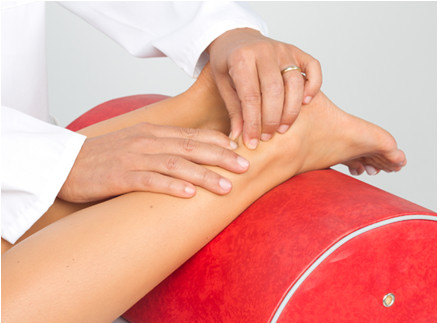
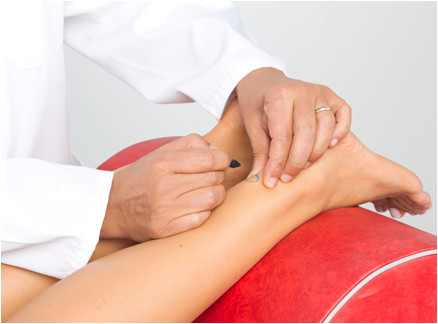
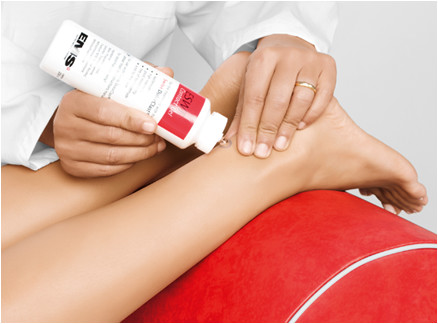
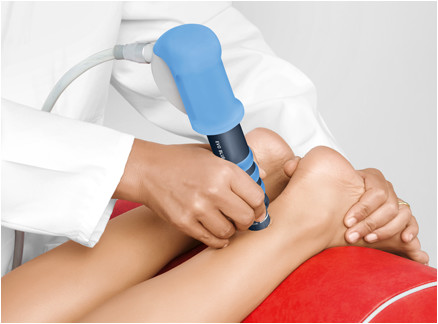
Medical information
The Achilles tendon is formed by the combined tendons of the soleus and gastrocnemius muscles (calf muscles), connecting them to the back of the heel. Mid-portion Achilles tendinopathy (MPAT) is an acute or chronic painful condition affecting the Achilles tendon.
Different terms have been used to describe this condition, including tendinosis, tendinitis, and peritendinitis. However, histological examination of tissue samples (biopsies) obtained from patients undergoing surgery for chronic symptoms has shown that chronic MPAT is associated with degenerative changes within the tendon. Accordingly, the condition is more accurately described as tendinopathy rather than tendinitis or tendinosis.
The Achilles tendon is surrounded, together with the plantaris tendon, by a paratenon. In many cases of Achilles tendinopathy, the condition is accompanied by paratendinopathy.
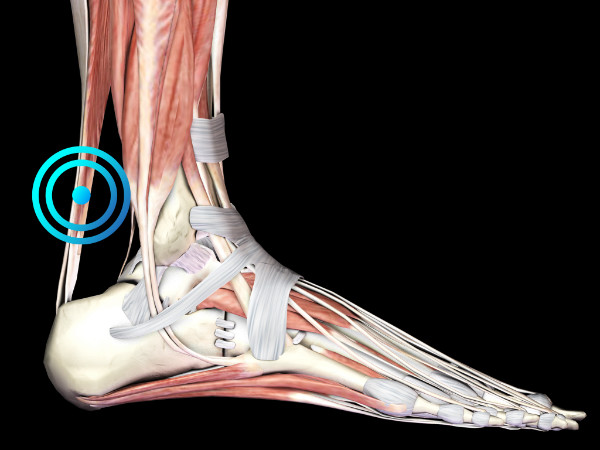
Diagnosis is based on the clinical characteristics of the condition, with the location of pain being an important distinguishing factor. In MPAT, the point of maximum pain and painful swelling is located 2 to 6 cm proximal to the tendon insertion, whereas in insertional Achilles tendinopathy, the point of maximum pain is located at the tendon-bone junction. Symptoms may worsen when standing up after a period of rest.
In isolated paratendinopathy, local thickening of the paratenon occurs, and the inflamed area does not move during ankle dorsiflexion and plantar flexion. In contrast, in isolated tendinopathy, the inflamed area moves with ankle dorsiflexion and plantar flexion. Imaging studies should be used to rule out other causes of Achilles tendon pain or to confirm the diagnosis of MPAT when uncertainty exists.
As with insertional Achilles tendinopathy, the etiology of MPAT is likely multifactorial and may include factors such as ageing, obesity, hypertension, diabetes, and steroid use, among others. In athletes, the onset of MPAT may also be influenced by harmful training habits, including overtraining, training on hard or inclined surfaces, and sudden changes in training schedules.
It has been hypothesised that the healing of Achilles tendon injuries resulting from overuse involves the ingrowth of small blood vessels from the paratenon into the tendon, increasing healing by improving blood supply. However, these small blood vessels are accompanied by small nerve fibres containing high concentrations of nociceptive substances such as glutamate, substance P, and calcitonin gene-related peptide (CGRP). These small nerve fibres are considered to be responsible for pain in chronic MPAT.
The lifetime risk of Achilles tendon injury in elite long-distance runners is approximately 50%. However, individuals of all activity levels and all ages may present with similar symptoms, and approximately 30% of patients have a sedentary lifestyle.
Treatment of MPAT should begin with conservative measures such as rest, ice application, physiotherapy, stretching exercises (eccentric loading), orthotic support, insoles, and the administration of non-steroidal anti-inflammatory drugs (NSAIDs). Patients who do not respond to conservative treatment within six months may be considered for radial extracorporeal shock wave therapy (rESWT®). In more persistent cases of MPAT, surgery should be considered, using different surgical strategies aimed at tendon debridement or tenotomy of the tendon itself.
STUDIES
Rompe JD, Furia J, Maffulli N Eccentric loading versus eccentric loading plus shock-wave treatment for midportion achilles tendinopathy: a randomized controlled trial.Am J Sports Med 2009;37:463-470. Refer to the study
Rompe JD, Nafe B, Furia JP, Maffulli N Eccentric loading, shock-wave treatment, or a wait-and-see policy for tendinopathy of the main body of tendo Achillis: a randomized controlled trial.Am J Sports Med 2007;35:374-383. Refer to the study
FOCAL PROTOCOL
Penetration depth: 5–15 mm
Total energy flux density per shock wave emission: 0.089–0.238 mJ/mm²
Number of sessions: 3–5 (1 per week)
Frequency: 8 Hz
Pulses: 2,000–3,000
STUDIES
Ludger Gerdesmeyer, Rainer Mittermayr, Martin Fuerst, Munjed Al, Muderis, Richard Thiele, Amol Saxena, Hans Gollwitzer Current evidence of extracorporeal shockwave therapy in chronic Achilles tendinopathy, Review International Journal of Surgery 24 (2015) 154e159.
L. Gerdesmeyer, M. Maier, M. Haake, C. Schmitz, Physical-technical principles of extracorporeal shockwave therapy (ESWT), Orthopade 31 (2002) 610e617.
L. Gerdesmeyer, C. Frey, J. Vester, et al, Radial extracorporeal shockwave Therapy is safe and effective in the treatment of chronic recalcitrant plantar fasciitis: results of a confirmatory randomized placebo-controlled multicenter study, Am. J. Sports Med. 36 (2008) 2100e2109.
P. Diehl, H. Gollwitzer, J. Schauwecker, T. Tischer, L. Gerdesmeyer, Conservative treatment of chronic tendinopathies, Orthopade 43 (2014) 183e193. [4] M.A. Childress, A. Beutler, Management of chronic tendon injuries, Am. Fam. Physician 87 (2013) 486e490.
J.A. Peters, J. Zwerver, R.L. Diercks, M.T. Elferink-Gemser, I. van dA-S, Preventive Interventions for tendinopathy: a systematic review, J. Sci. Med. Sport. (2015 Apr 1) 1440e2440.
R. Zwiers, J.I. Wiegerinck, C.N. van Dijk, Treatment of midportion Achilles tendinopathy: an evidence-based overview, Knee Surg. Sports Traumatol. Arthrosc. 22 (2014) 1433e7347.
B. Magnan, M. Bondi, S. Pierantoni, E. Samaila, The pathogenesis of Achilles tendinopathy: a systematic review, Foot Ankle Surg. 20 (2014) 154e159.
M.F. Joseph, K.R. Lillie, D.J. Bergeron, et al, Achilles tendon biomechanics in response to acute intense exercise, J. Strength Cond. Res. 28 (2014) 1181e1186.
J.I. Wiegerinck, G.M. Kerkhoffs, M.N. van Sterkenburg, I.N. Sierevelt, C.N. van Dijk, Treatment for insertional Achilles tendinopathy: a systematic review, KneeSurg. Sports Traumatol. Arthrosc. 21 (2013) 1345e1355.
V. Rowe, S. Hemmings, C. Barton, P. Malliaras, N. Maffulli, D. Morrissey, Conservative management of midportion Achilles tendinopathy: a mixed methods study, integrating systematic review and clinical reasoning, Sports Med. 42 (2012) 941e967.
K. Knobloch, The role of tendon microcirculation in Achilles and patellar tendinopathy, J. Orthop. Surg. Res. 3 (2008) 18.
P. Diehl, H. Gollwitzer, J. Schauwecker, T. Tischer, L. Gerdesmeyer, Conservative Treatment of chronic tendinopathies, Orthopäde 43 (2014) 183e193.
R. Kearney, M.L. Costa, Insertional Achilles tendinopathy management: a Systematic review, Foot Ankle Int. 31 (2010) 689e694.
J.P. Furia, Extracorporeal shockwave therapy in the treatment of chronic insertional Achilles tendinopathy, Orthopade 34 (2005) 571e578.
U. Balasubramaniam, R. Dissanayake, L. Annabell, Efficacy of platelet-rich plasma injections in pain associated with chronic tendinopathy: a systematic review, Phys. Sportsmed. (2015) 1e9.
R.S. Kearney, N. Parsons, D. Metcalfe, M.L. Costa, Injection therapies for Achilles tendinopathy, Cochrane Database Syst. Rev. 5 (2015). CD010960.
N. Maffulli, R. Papalia, S. D'Adamio, B.L. Diaz, V. Denaro, Pharmacological interventions for the treatment of Achilles tendinopathy: a systematic review of Randomized controlled trials, Br. Med. Bull. 113 (2015) 101e115.
J.P. Furia, High-energy extracorporeal shockwave therapy as a treatment for insertional Achilles tendinopathy, Am. J. Sports Med. 34 (2006) 733e740.
M.L. Costa, L. Shepstone, S.T. Donell, T.L. Thomas, Shockwave therapy for chronic Achilles tendon pain: a randomized placebo-controlled trial, Clin. Orthop. Relat. Res. 440 (2005) 199e204.
J.P. Furia, High-energy extracorporeal shockwave therapy as a treatment for Chronic non insertional Achilles tendinopathy, Am. J. Sports Med. 36 (2008)502e508.
S. Rasmussen, M. Christensen, I. Mathiesen, O. Simonson, Shockwave therapy for chronic Achilles tendinopathy: a double-blind, randomized clinical trial of efficacy, Acta Orthop. 79 (2008) 249 e256.
J.D. Rompe, B. Nafe, J.P. Furia, N. Maffulli, Eccentric loading, shock-wave treatment, or a wait-and-see policy for tendinopathy of the main body of tendo Achillis: a randomized controlled trial, Am. J. Sports Med. 35 (2007) 374e383.
J.D. Rompe, J. Furia, N. Maffulli, Eccentric loading compared with shockwave Treatment for chronic insertional Achilles tendinopathy. A randomized, Controlled trial, Am J Sports Med. 2009 Mar;37(3):463-70.
K.Feeney, The Effectiveness of Extracorporeal Shockwave Therapy for Midportion Achilles Tendinopathy: A Systematic Review, Cureus, 2022 Jul; 14(7): e26960.
I.Jarin , H.C. Baker , J.Turner Vosseller Functional Outcomes of Insertional Achilles Tendinopathy Treatment: A Systematic Review JBJS Rev 2021 Jun 14;9(6).