

Medial Epicondylitis (Golfer's Elbow)
RADIAL PROTOCOL
Radial protocol values
Pressure: 1.5 to 3 bar
Impulses: 2000
Frequency: 8 Hz to 12 Hz
Applicator: 12 mm
Number of sessions: 3 to 5 (1 per week)
Medical Information
In previous times, this injury was commonly referred to as "medial epicondylitis." However, it is now believed that it is not an inflammatory pathology. Today, the most accurate description would be "partially reversible, yet degenerative, over/underuse tendinopathy." Due to the complexity of this description, the term "golfer's elbow" is generally used.
The anterior part of the forearm contains several muscles involved in finger flexion, as well as wrist flexion and pronation. The tendons of these muscles join in a common tendon sheath, which originates from the medial epicondyle of the humerus at the elbow joint. In response to a minor injury, or sometimes for no apparent reason, this insertion point becomes inflamed.
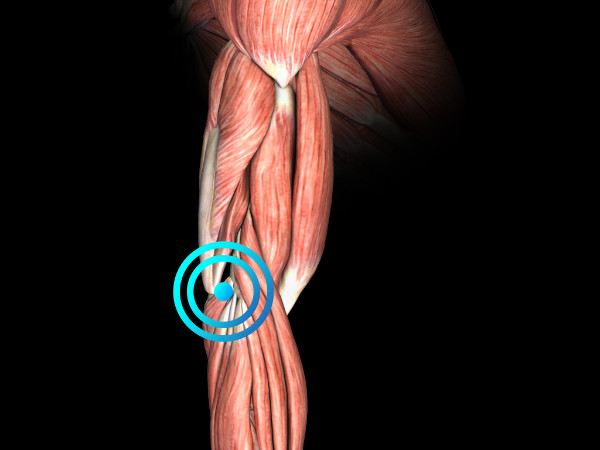
Initial treatment should be conservative, consisting of rest, physiotherapy, and non-steroidal anti-inflammatory drugs (NSAIDs). As with chronic Achilles tendinopathy and chronic plantar fasciopathy, eccentric exercises have become the mainstay of rehabilitation programs for golfer's elbow.
In most cases, cortisone injections should not be used, as cortisone provides very good short-term results (six weeks) but has been shown to be detrimental in the long term (more than three months). Surgery should be considered when conservative treatment fails.
An attractive alternative for the treatment of golfer's elbow is radial shock wave therapy.
Although cortisone achieves very good results in the short term (six weeks), it has been proven to be harmful in the longer term (more than three months). When conservative treatment fails, surgery should be considered.
STUDIES
Die radiale Stosswellentherapie bei der Epikondylitis humeri radialis – kurz- und mittelfristige Ergebniss.
Söller F.
In: Maier M, Gillesberger F: Abstracts 2003 zur Muskuloskelettalen Stosswellentherapie. Norderstedt 2003; 121-122
Shock Wave therapy for tennis and golfers’s elbow – 1 year follow up.
Krischnek O, Hopf C, Nate b, et al.
Arch Orthop Trauma Surg 1999; 62-66