
Erectile dysfunction
FOCAL PROTOCOL
Focal protocol values
Pad: 10 mm
Intensity: 20
Frequency: 6–8 Hz
Total number of sessions: 4 to 6 over a period of 14 to 30 days.
Interval between sessions: weekly or at least 3 days apart.
MOTIL ALGORITHM
(Click here to access the MOTIL algorithm calculator)
This algorithm is the first of its kind and suggests the optimal number of shockwaves (and therefore the energy dose) to be applied to the cavernosal tissue during a single session in order to successfully treat Erectile dysfunction using low-intensity linear shockwaves delivered with the Richard Wolf PiezoWave2 system.
The algorithm was developed by Dr. Igor Motil (Brno) based on his extensive experience and studies in this type of treatment. The goal was to improve treatment outcomes by adapting the therapy to each individual patient. The algorithm takes into account important factors that may influence treatment results, such as the baseline IIEF-5 score and patient comorbidities. However, it should be emphasized that medical science is continuously evolving, and Dr. Motil reserves the right to make changes in the future.
This LSTC-ED algorithm is only suitable for use with the Richard Wolf PiezoWave2 shockwave systems combined with the FBL10x5 G2 linear applicator. We do not recommend using this algorithm with other devices that feature a different shockwave therapeutic volume shape or energy delivery profile than the G2.
Disclaimer
None of the data, results, and experiences underlying this algorithm and website may be interpreted as a basis for any claim against CORR MEDICAL S.L., ELvation Medical GmbH, Richard Wolf GmbH, or Dr. Igor Motil. Any liability based on legal regulations is limited to cases of gross negligence or intentional misconduct. All information related to settings, application sites, duration of applications, and the general use of the technology is based on clinical experience and is provided for training purposes only. However, the applicability of this information must be verified by trained medical end users authorized to operate shockwave systems.
This information is not intended to replace the guidance provided in the latest User Manuals for the various shockwave systems. Depending on individual circumstances, it may be necessary to deviate from the recommended values and settings. Medical knowledge is constantly evolving as a result of ongoing research and clinical developments. Therefore, deviations from the information provided on this website and within this algorithm may become necessary.
Note: Treatment of Erectile dysfunction with the PiezoWave2 device. Application of low-intensity shockwaves using the new Linear Shockwave Tissue Coverage technique (LSTC-ED®). A prospective, multicenter, placebo-controlled study. Motil et al.
TREATMENT
Currently, many andrologists use shockwave therapy to treat Erectile dysfunction (ED), with excellent outcomes reported by patients.
The use of low-energy focused shockwaves has demonstrated effectiveness in cases of vasculogenic Erectile dysfunction. Following a review of the available scientific evidence, this therapy has been recognized as a first-line treatment in the clinical guidelines of the European Association of Urology (EAU).
Initially, wider adoption of the treatment was limited by the irregular and slow delivery of energy to the corpora cavernosa. This changed with the introduction of piezoelectric shockwave technology, capable of generating linear focused shockwaves that can cover larger areas of erectile tissue.
This advancement was incorporated into the new therapeutic approach known as LSTC-ED (Linear Shockwave Tissue Coverage – Erectile Dysfunction). The combination of this technology with an optimized application technique significantly improved both energy distribution and therapeutic outcomes.
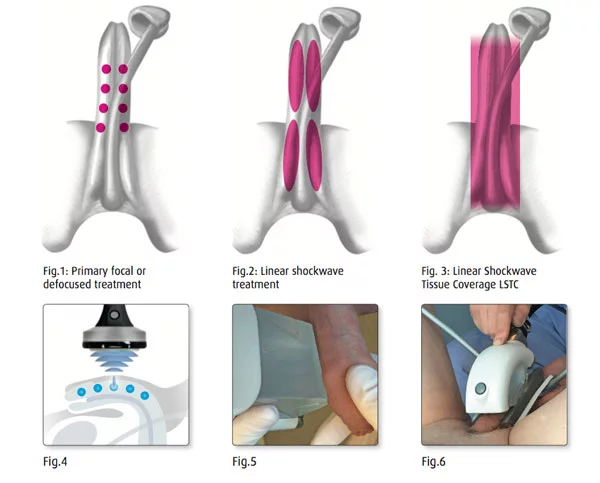
For the first time, it became possible to treat the entire corpora cavernosa quickly and comprehensively. During the procedure, the shockwave source is applied perpendicularly to the penis and then moved longitudinally along the shaft (corpora cavernosa) and the perineum (crural area). This technique ensures uniform and effective energy distribution. The treatment can be completed within a few minutes.
To support this technique with robust scientific evidence, a prospective, multicenter, placebo-controlled study involving 75 patients was conducted. The results demonstrated a significant improvement in IIEF-5 questionnaire scores, with a treatment success rate of 81% one month after therapy. In addition, the positive effects were maintained for up to six months, demonstrating the long-lasting benefits of LSTC-ED therapy.
RECOMMENDED PRODUCTS
STUDIES
Treatment of Vasculogenic Erectile Dysfunction with Piezowave2 Device. Application of Low Intensity Shockwaves Using Novel Linear Shockwave Tissue Coverage (LSTC-ED®) Technique. A Prospective, Multicentric, Placebo-Controlled Study. (Igor Motil, Ivan Kubis, Tatana Sramkova). Published Online April 2016 in SciRes.
Prognostic Indicators for Successful Low-intensity Extracorporeal Shock Wave Therapy Treatment of Erectile Dysfunction. Adeldaeim, Hussein M. et al. Urology, Volume 149, 133 - 139
Lurz K, Dreher P, Levy J, et al. (November 01, 2020) Low-Intensity Shockwave Therapy in the Treatment of Erectile Dysfunction. Cureus 12(11): e11286. doi:10.7759/cureus.11286
J. Levy, D. Edwards, N. Dilenno, P. Dreher, K. Lurz, C. Zinar, L. Belkoff, K. Lurz, 125 Linear Shockwave Tissue Coverage (LTSC) in the Treatment of Erectile Dysfunction (ED), The Journal of Sexual Medicine, Volume 16, Issue Supplement_3, June 2019, Page S49, https://doi.org/10.1016/j.jsxm.2019.03.562
Erectile Dysfunction Treatment Using Focused Linear Low-Intensity Extracorporeal Shockwaves: Single-Blind, Sham-Controlled, Randomized Clinical Trial. Urol Int (2020) 104 (5-6): 417–424. https://doi.org/10.1159/000504788
C. Ratz, C.H.R. Ratz, S. Thieme-Martens, 654 Long-term Results of Patient Satisfaction After Low-intensity Shockwave Treatment (Li ESWT) of Erectile Dysfunction and Peyronie's Disease in an Urological Private Practice, The Journal of Sexual Medicine, Volume 15, Issue Supplement_3, July 2018, Page S378, https://doi.org/10.1016/j.jsxm.2018.04.561
Sokolakis, I., Hatzichristodoulou, G. Clinical studies on low intensity extracorporeal shockwave therapy for erectile dysfunction: a systematic review and meta-analysis of randomised controlled trials. Int J Impot Res 31, 177–194 (2019). https://doi.org/10.1038/s41443-019-0117-z
Abou Taleb, W. El-Shaer, W. kandeel, A. dakhakhny, E. el nahif, A. Abd Elbaky, 316 Low Intensity Shock Wave Tissue Coverage for Management of Erectile Dysfunction Patients: Preliminary Comparative Study, The Journal of Sexual Medicine, Volume 15, Issue Supplement_3, July 2018, Pages S251–S252, https://doi.org/10.1016/j.jsxm.2018.04.279
Jawad Antoine Feghali, 06 LISWT Might Improve the Genitoperineal Sensation and Erectile Dysfunction in Neurogenic and Diabetic Patients, The Journal of Sexual Medicine, Volume 14, Issue Supplement_6, December 2017, Page e390, https://doi.org/10.1016/j.jsxm.2017.10.008
de Oliveira, P. S., de Oliveira, T. R., Nunes, Álvaro, Martins, F., & Lopes, T. (2019). Low-intensity shock wave therapy for erectile dysfunction and the influence of disease duration. Archivio Italiano Di Urologia E Andrologia, 90(4), 276–282. https://doi.org/10.4081/aiua.2018.4.276
Early outcomes of short-course low intensity shockwave therapy (LiSWT) for erectile dysfunction: A prospective, randomized, double-blinded, sham-controlled study in Malaysia. https://doi.org/10.1111/and.14518
Naser, Fazal & Hasan, Mahmood & Islam, Md & Chowdhury, Tajkera & Hossain, Md. (2020). Low intensity Extra Corporeal Shock Wave Therapy in Patients with Erectile Dysfunction: Our experience in ACKU. Bangladesh Journal of Urology. 23. 176-180. 10.3329/bju.v23i2.50311.
J. Levy, D. Edwards, N. Dilenno, P. Dreher, K. Lurz, C. Zinar, L. Belkoff, K. Lurz, 125 Linear Shockwave Tissue Coverage (LTSC) in the Treatment of Erectile Dysfunction (ED), The Journal of Sexual Medicine, Volume 16, Issue Supplement_3, June 2019, Page S49, https://doi.org/10.1016/j.jsxm.2019.03.562