

Chronic pelvic pain syndrome (Abacterial prostatitis)
FOCAL PROTOCOL
Focal protocol values
Energy: 0.25 mJ/mm²
Impulses: 3000
Sessions: 6
Frequency: 3 Hz
Interval: 7 days
MEDICAL INFORMATION
It is the urinary and pelvic dysfunction accompanied by suprapubic, perianal, inguinal, and/or prostatic pain, showing poor response to pharmacological treatments such as Botulinum Toxin, neuromodulation, or physiotherapy. Extracorporeal shock waves have been observed to induce analgesia, reduce inflammation, and promote tissue regeneration.
The pelvic floor muscles line the minor pelvis like an internal elastic "basket." This means that pelvic floor trigger points (TPs) are located at very different depths. ELvation Medical and Richard Wolf GmbH have developed a special therapy source for pelvic floor treatment that takes this specific anatomy into account. Thanks to the highly elongated focal zone of the F10G10 therapy source, TPs in all regions of the pelvic floor can be reached.
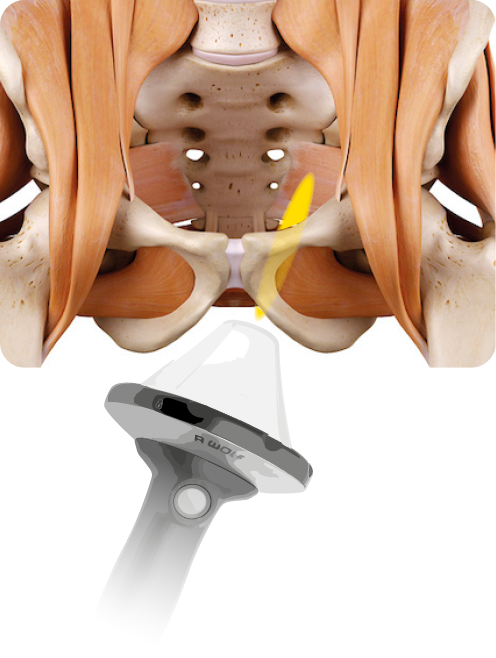
APPLICATION TECHNIQUE
First, the objective is to focus the shock wave on the affected trigger point(s). Shock waves are not felt in the surrounding healthy tissue, but when they impact a trigger point, they are painful and usually correspond exactly to the pain experienced by the patient. Typically, trigger point pain decreases after just a few shock wave pulses. The position of the therapy source is then adjusted to locate the next trigger point, which is usually only a few millimeters away.
In subsequent treatments, the trigger point areas exhibit less pain and the intensity can usually be increased, indicating that trigger point activity is decreasing and that the therapy is effective.
FOLLOW-UP REVIEWS
The follow-up schedule typically consists of clinical examinations and re-evaluation based on a quality-of-life questionnaire 12 weeks after the shock wave application. The degree of pain can be assessed using the visual analogue scale (VAS: 0-10). Prostatitis-related discomfort was investigated using the index developed by the NIH Chronic Prostatitis Symptom Index (NIH-CPSI).