

RADIAL PROTOCOL
Radial protocol values
Pressure: 2 bar
Impulses: 2,500
Frequency: 10–12 Hz
Applicator: 15 mm
Total energy flux density dose: 103 mJ/mm²
Number of sessions: 3 (1 per week)
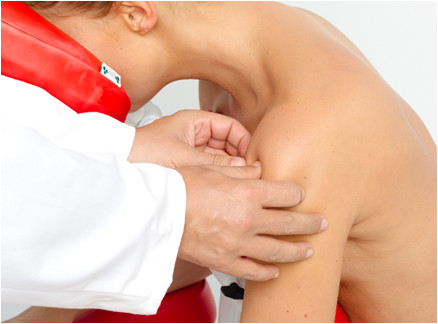
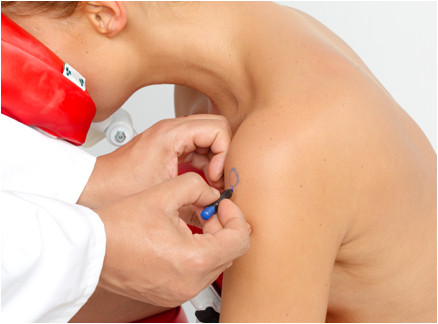
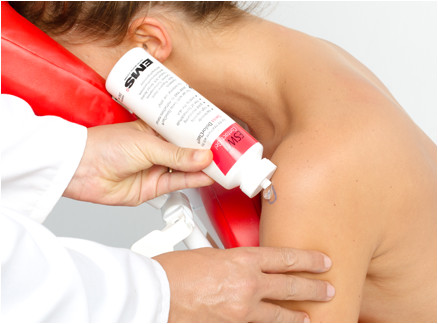
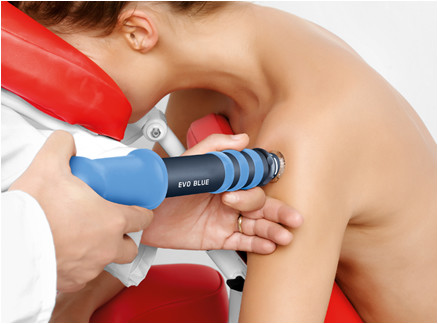
Medical Information
Calcific tendinitis of the shoulder is an acute or chronic painful condition characterized by the presence of calcifications in the rotator cuff tendons.
Its main clinical symptom is shoulder pain when raising the arm above shoulder level. The pain may become severe enough to wake the patient during the night. Other associated symptoms may include weakness, stiffness, clicking sensations, or shoulder locking. The condition is diagnosed based on clinical symptoms and imaging studies. In most cases, calcifications are located in the supraspinatus tendon (51%–90%) and less frequently in the subscapularis tendon (3%).
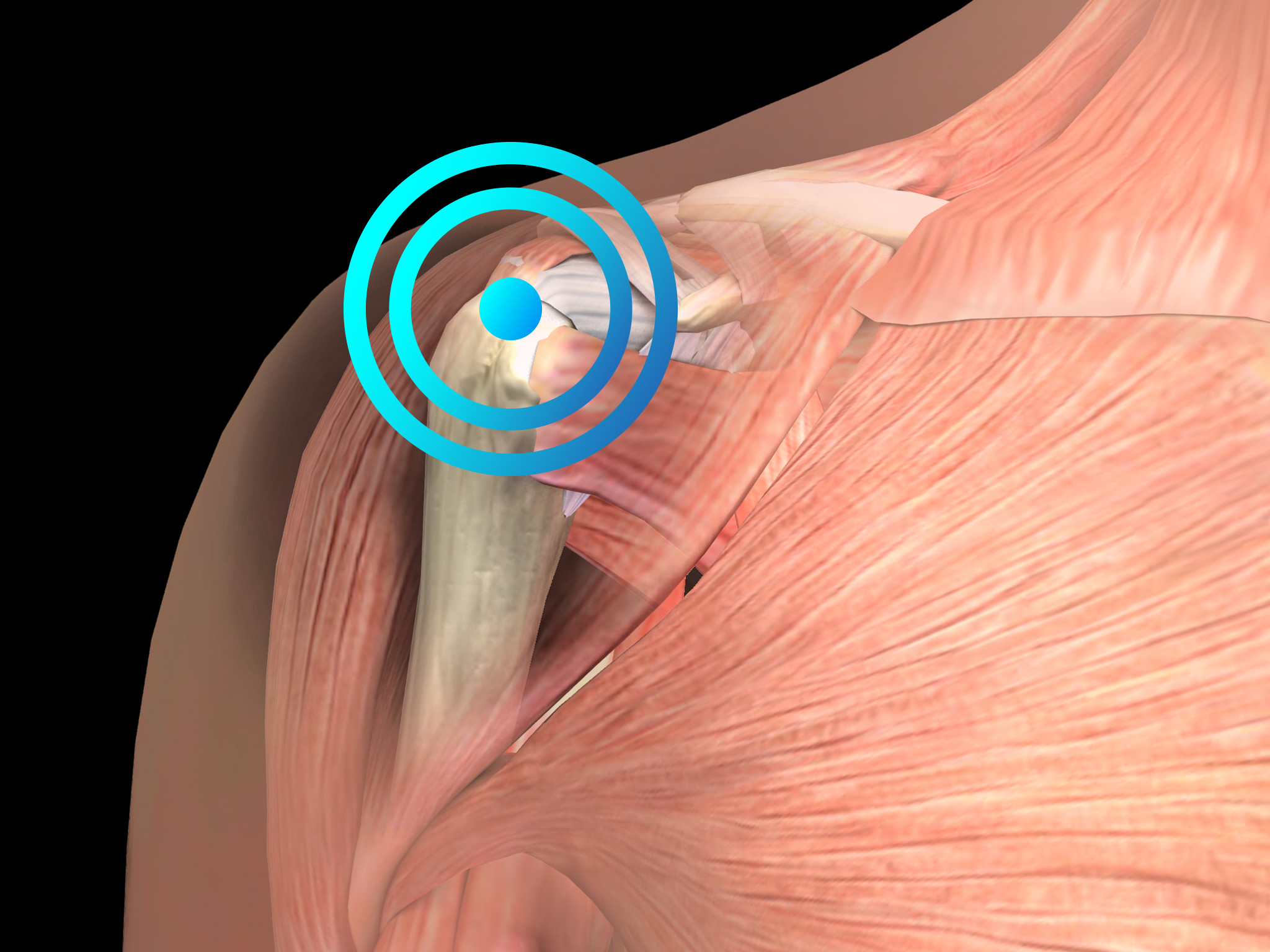
Many aspects of the etiology of this condition remain unknown. One hypothesis suggests that the disorder may be related to fibrosis and necrosis induced by tendon hypovascularization, leading to tendon degeneration. The characteristics of previously existing asymptomatic calcium deposits may change following minor traumatic events, resulting in acute symptoms. The condition may also arise from mechanical irritation caused by the deposits when the arm moves away from the body’s midline and the deposits come into contact with the acromion.
This condition generally progresses through four stages:
Pre-calcific stage (usually asymptomatic), involving fibrocartilaginous metaplasia within the tendon;
Formative stage (with or without pain), during which calcium deposits develop within the fibrocartilaginous matrix;
Resorptive stage (severe pain), in which the deposits disappear through cell-mediated resorption associated with an inflammatory response;
Final stage (with or without pain), involving healing and repair of the rotator cuff. It should be noted that this cycle may become arrested at any stage, resulting in chronic calcific tendinitis.
This condition affects approximately 3% of the healthy population and around 7% of individuals with shoulder pain. The highest incidence occurs between 30 and 50 years of age. The condition is twice as common in women as in men.
Initial treatment should generally be conservative and may include rest, physiotherapy, and non-steroidal anti-inflammatory medication. In more advanced stages, radial shock wave therapy may be considered (although never during the resorptive stage), as well as subacromial corticosteroid injections. In more persistent cases of calcific tendinitis of the shoulder, surgical intervention should be considered.
STUDIES
Magosch P, Lichtenberg S, Habermeyer P Radiale Stosswellentherapie der Tendinosis calcarea der Rotatorenmanschette – Eine prospektive Studie.Z Orthop Ihre Grenzgeb 2003; 141 : 629-636
Gremion G, Augros R, Gobelet C, et al. Efficacité de la thérapie par ondes de choc extra corporelles dans les tendinites calcifiantes de l’épaule 2000
FOCAL PROTOCOL
Focal protocol values
Penetration depth: 10–25 mm
Total energy flux density per shock wave emission: 0.077–0.317 mJ/mm²
Number of sessions: 3–5 (1 per week)
Frequency: 8 Hz
Impulses: 2,000–2,500
Medical Information
Calcific tendinosis is a common cause of shoulder pain, particularly in individuals between 30 and 60 years of age. The etiology of the condition has not yet been fully clarified. Calcifications develop within the rotator cuff tendons and typically progress through defined stages or evolutionary cycles. The supraspinatus and infraspinatus muscles are most commonly affected.
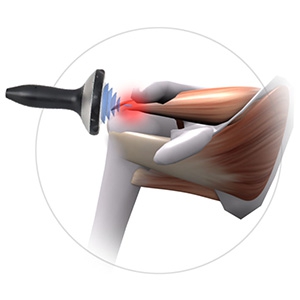
A distinction is made between the acute and chronic phases of the condition. Initially, patients usually report pain only during specific movements, particularly circular movements or when raising the arm above the head, actions in which the rotator cuff plays a major role. In later stages, patients may also experience pain at rest. Intermittent episodes of acute pain are characteristic of calcific tendinitis of the shoulder. Focused shock wave therapy has become an established ESWT treatment option.
STUDIES
Bosworth B.Calcium deposits in the shoulder and subacromial bursitis: a survey of 12122 shoulders. JAMA 1941; 116:2477-2489.
Uhthoff HK, Loehr JF Calcifying tendinitis. In: Rockwood CA, Matsen FA (eds): The shoulder.Saunders,Philadelphia(1998),989-1008.
Harmon PH. Methods and results in the treatment of 2580 painful shoulders with special reference to calcific tendinitis and the frozen shoulder. Am J Surg 1958; 95:527-544.
Gärtner J. Tendinosis calcarean: treatment results with needling. Z Orthop IhreGrenzgeb1993; 131:461-469.
Rompe JD, Buch M, Gerdesmeyer L, Haake M, Loew M, Maier M, Heine J. Musculoskeletal shock wave application- Current status of clinical research on standard indications. Z Orthop Your Bordergeb 2002; 140:267-274.
Green S, Buchbinder R, Glazier R, Forbes A. Systematic review of randomised controlled trials of interventions for painful shoulder: selection criteria, outcome assessment, and efficacy. BMJ 1998; 316:354-360.
Rochwerger A, Franceschi JP, Viton JM. Surgical management of calcific tendinitis of the shoulder: an analysisof26cases.ClinRheumatol1999;18:313-316.
Loew M, Daecke W, Kusnierczak D, Rahmanzadeh M, Ewerbeck V. Extracorporal shockwave application-an effective treatment for patients with chronic and therapy-resistant calcifying tendinitis? J BoneJointSurg1999 ;81-B:863-867.
Constant CR, Murley AHG.A clinical method of functional assessment of the shoulder. Clin Orthop1987; 214:160-164.
Rompe JD,Zoellner J,Nafe,B.Significance of calcium depo elimination in tendinosis calcarea of the shoulder.ZOrthop Your Grenzgeb 2000;138:335-339.
Daecke W, Kusnierczak D, Loew M: Importance of extra corporeal shockwave therapy (ESWT) in chronic calcific tendinitis of the shoulder. Orthopäde 2002;-31:645-651.
Gerdesmeyer L, Wagenpfeil S, Haake M, Maier M, Loew M, Wörtler K, Lampe R, Seil R, Handle G, Gassel S, Rompe JD: Extracorporeal shockwave therapy for the treatment of chronic calcifying tendonitis of the rotator cuff-a randomized controlled trial.JAMA(2003);290:2573-258.
Balajy Umamahesvaran, Calcifying Tendinitis of Shoulder: A Concise Review, J Orthop. 2018 Sep; 15(3): 776-782.