

Acute and chronic soft tissue lesions (chronic venous insufficiency, diabetic ulcer, neuropathic or neurotrophic ulcer)
FOCAL PROTOCOL
Focal protocol values
An ankle-brachial index between 0.66 and 1.8 is considered the treatable range.
Intensity: 20
Frequency: 5Hz to 8Hz
Applicator: FBL 10x5 G2 focal linear applicator
Gel pad: 0mm
Between 500 and 1000 pulses per cm²
Energy flux density per pulse: 0.16mJ/mm²
Number of sessions: 3 to 8 (1 or 2 per week)
Medical Information
WOUND TREATMENT WITH SHOCKWAVE THERAPY
Extracorporeal shockwave therapy (ESWT) is a non-invasive procedure that may stimulate wound healing.
For a long time, the biological mechanism of action by which shockwaves improve wound healing was not fully understood; however, their effects have been accurately described. Research findings have been confirmed by clinical outcomes showing significant improvements in wound healing.
In recent years, numerous scientific studies and publications, some of which also used focal piezoelectric shockwaves, have described the mechanism of action through which wound healing is stimulated. Essentially, ESWT is a strong and targeted mechanical stimulus that promotes biological self-healing processes. Upon closer examination, this broad statement encompasses a series of complex shockwave effects. Mechanical stimuli affect many cellular functions in living tissue, including cell growth, cell differentiation, cell migration, protein synthesis, physiological apoptosis, and tissue necrosis. Extracorporeal shockwaves act as mechanical stress factors and induce biochemical changes in living tissue which, at the molecular level, ultimately affect cellular gene expression; when shockwaves are selectively applied, they can trigger specific tissue responses. This process is known as mechanotransduction.
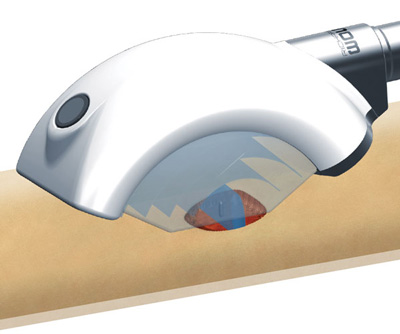
The focal zone of a piezoelectric shockwave is the area (-6dB zone) in which the maximum positive peak pressure falls to half of the peak pressure. Shockwaves exhibit a three-dimensional spatial distribution along the x, y, and z axes. This focal zone can be adjusted to precisely target the treatment area, while also minimizing trauma to adjacent tissue.
With the Richard Wolf PiezoWave2 system, the focal zone of a focused piezoelectric therapy source (FBL10x5G2, intensity 10) has a three-dimensional volume of 46 mm x 20 mm x 4 mm. Due to the direct focusing technology of piezoelectric shockwave systems, the size of the focal zone changes only minimally, even when the intensity setting is adjusted. The penetration depth of the focal zone is preselected using gel pads of different thicknesses. A special feature of focused linear shockwaves is the option to select a “0” gel pad. Half of the focal zone remains within the gel pad, ensuring that the maximum pressure at the focal center is positioned precisely at skin level.
STUDIES
Treatment of chronic wounds with extracorporeal shockwave therapy – an experience report (C. Moosmann, C. Grabosch, B. Jänigen)
H. G. Neuland, H. J. Duchstein. Manifestation Pattern of the Extracorporeal Shock Wave Therapy using Mechanotransduction. Orth.Praxis 4.2006
H. G. Neuland, A. Schmidt. Induction of Adult (Tissue-specific) Mesenchymal Stem Cells through Extracorporeal Shock Waves to Regenerate Muscoskeletal Tissue. Orth.Praxis 2006
Laura Berta, Annamaria Fazzari, Anna Maria Ficco, Patrizia Maurici Enrica, Maria Graziella Catalano, and Roberto Frairia. Extracorporeal shock waves enhance normal fibroblast proliferation in vitro and activate mRNA expression for TGF-D1 and for collagen types I and III. Acta Orthopaedica 2009; 80 (5): 612-617
Giuliana Muzio, PhD, Enrica Verne et al . Shock Waves Induce Activity of Human Osteoblast-Like Cells in Bioactive Scaffolds. The Journal of Trauma Injury, Infection, and Critical Care 2010
J. Fehre, W. Kraut, A. Lutz, R. Reitmajer, A. TOth-Kischkat, F. Ueberle, 0. Wess. Fokussierte und unfokussierte Druck und StoRwellen - Unterschiede und Gemeinsamkeiten Eine Abhandlung erstellt durch den wissenschaftlichen Beirat Physik / Technik der DIGEST
Mayer, D; Dorfm(iller,C; Lachat,M. Die extracorporale Stogwellentherapie als neue Methode zur Stimulation der heilung komplexer Wunden: Eine Ubersicht. Zeitschrift fur Wundheilung 2009, 232-237
Chen YJ, Wurtz T, Wang CJ, Kuo YR et al. Recruitment of mesenchymal stem cells and expression of TGF-beta 1 and VEGF in the early stage of shock wave-promoted bone regeneration of segmental defect in rats.J Orthop Res. 2004 May;22(3):526-34
Wang C, Kuo R, Wu R. Extracorporeal shockwave treatment for chronic diabetic foot ulcers. J Surg Res 2009; 152: 96-103
Kerstin Birte Neumann. Untersuchung der Wirkung Extrakorporaler Stosswellentherapie auf die Haut. Effekte der Mechanotransduktion auf Fibroblasten in-vitro und Analyse von Hautveranderungen in-vivo. Dissertation zur Erlangung des Dr. rer. nat. der Universitat Hamburg
Janigen B, Moosmann C, Hopt U. Die Behandlung therapieresistenter Wunden beim diabetischen Fugsyndrom mittels extrakorporaler Stosswellentherapie (ESWT) Zeitschrift fur Wundheilung 18.Jahrgang 6.2013 Abstractband: ISSN1439-670x